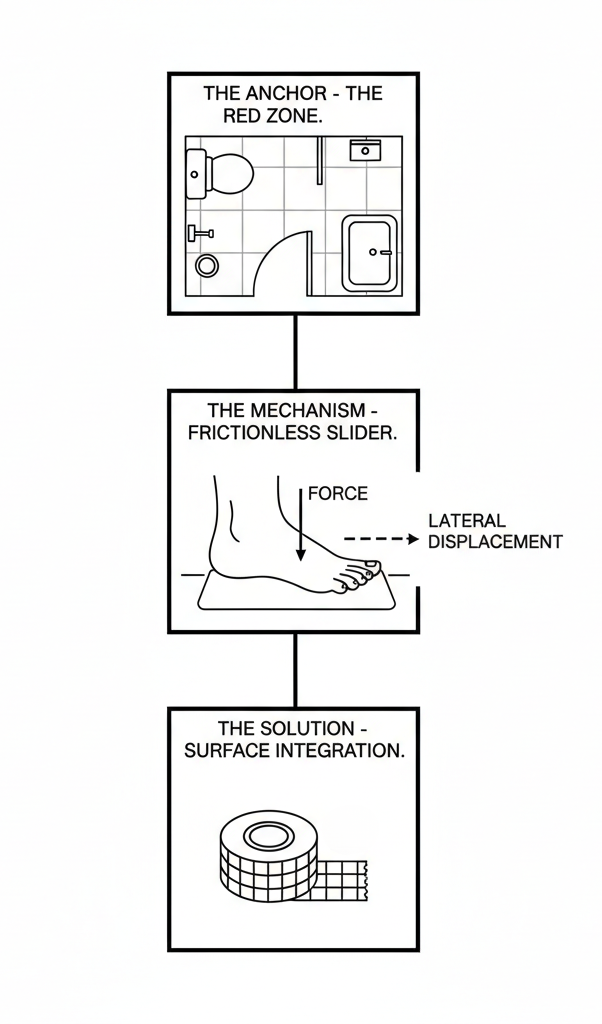
You spend your time worrying about the stairs. It makes sense; the stairs look dangerous. But while you are watching the staircase, the real threat is hiding in plain sight on the bathroom floor.
The bathroom is the "Red Zone" of senior falls. It poses a disproportionate threat, responsible for 81% of injuries in the home for individuals over 85.
Many caregivers and seniors rely on the "Carefulness Fallacy"—the belief that if Mom or Dad just "pays attention" and moves slowly, they will be safe. This is a dangerous misconception. A fall on a throw rug is not a failure of willpower or attention; it is a failure of physics.
We are going to look at the mechanics of why these falls happen and how to engineer them out of existence.
Throw rugs cause falls because they introduce a variable friction surface that acts as a "sled" when placed on hard tile, specifically when moisture acts as a lubricant.
The danger isn't just that the rug is an obstacle; it is that the rug fundamentally changes the physics of walking. When a senior steps onto a loose rug, they are relying on the friction between the rug and the floor to keep them upright. If that friction fails, the rug accelerates faster than the aging human brain can process.
The Anchoring Protocol is an Environmental Engineering Standard designed to eliminate variable friction by mechanically bonding walking surfaces to the sub-floor, ensuring the Available Coefficient of Friction (ACOF) always exceeds the demand of the footstep.
A slip is a friction failure resulting in a backward fall, while a trip is an obstruction resulting in a forward fall.
To prevent falls, you must understand the mechanics of how they happen. The throw rug is a "double agent" of instability because it can cause both, but the slip is often more deadly.
Feature
Mechanical Cause
Direction of Fall
Primary Injury Risk
Rug Hazard
The Slip
Friction Failure. The foot slides because the floor lacks "grip" (Low ACOF).
Backward. The foot accelerates forward, driving the Center of Mass (COM) backward.
Hip Fracture & TBI. The head or hips strike the hard floor/fixtures behind the senior.
Lack of backing/adhesion (rug moves)
The Trip
Obstruction. The foot hits an object (rug edge) and stops abruptly.
Forward. The foot stops; inertia throws the upper body forward.
Wrist/Face Trauma. Bracing for the fall often breaks wrists or injures the face.
Curled edges (foot catches).
"Being careful" fails because a slip occurs in 100 - 300 milliseconds, which is faster than the neural reaction time of an aging brain.
This is the "Dead Zone" of reaction time. By the time the senior's brain registers that the rug is moving, gravity has already won.
The physics of a safe step relies on a simple inequality: RCOF < ACOF
- RCOF (Required Coefficient of Friction): The grip the foot needs to not slide.
- ACOF (Available Coefficient of Friction): The grip the floor actually provides.
When a senior "walks carefully" (short, shuffling steps), they are unconsciously trying to lower their RCOF. However, a loose rug on a smooth tile drops the ACOF to near zero. No amount of careful walking can compensate for a floor that provides zero friction.
Water creates "hydrodynamic lubrication," forming a fluid film that separates the rug from the floor and eliminates friction.
Think of a car hydroplaning on a wet highway. The same thing happens in the bathroom. If there is dampness from a shower or sink, the water creates a barrier between the rug backing and the tile. The rug is no longer sitting on the floor; it is floating on a microscopic layer of water.
In this state, the rug becomes a frictionless slider. The moment a heel strikes it, the rug shoots forward, and the senior is driven backward with high velocity into the toilet, tub, or tile wall.
The solution is to apply the Anchoring Protocol: either remove the hazard entirely or mechanically bond it to the floor to increase friction.
You cannot change the laws of physics, but you can engineer the environment to respect them.
The Anchoring Protocol Checklist:
Elimination (Gold Standard):- Remove all loose throw rugs from the bathroom immediately.
-
This removes the variable completely and exposes the stable tile, which usually has a higher static friction coefficient than a loose rug.
Adhesion (If Rugs Must Stay):- If a rug is non-negotiable for comfort, it must be anchored.
-
Use heavy-duty, double-sided carpet tape along the entire perimeter.
-
Alternatively, use rubber-backed, industrial-grade non-skid mats that are rated for high-moisture environments.
Surface Roughness (Inside the Tub):- Use rubber mats or adhesive non-skid decals.
-
These create "asperities" (roughness) that penetrate the water film and allow the foot to grip the surface.
If your parent has a history of falls or "near misses" in the bathroom, do not describe them as "clumsy."
Report a "mismatch in environmental friction." This signals to the clinician that the issue may require an occupational therapy home evaluation rather than just physical therapy exercises.
You now have the intelligence; you just need the plan. Don't wait for a hip fracture to redesign the "Red Zone." Contact us to get started.
