You have likely told your parent a hundred times: "Please, just be careful."
It feels like the right advice. You see them walking tentatively, staring at their feet, and taking short, shuffling steps. It looks safer. But current clinical data reveals a dangerous paradox in senior mobility.
The "cautious" behavior you are encouraging may actually be the trigger for their next fall.
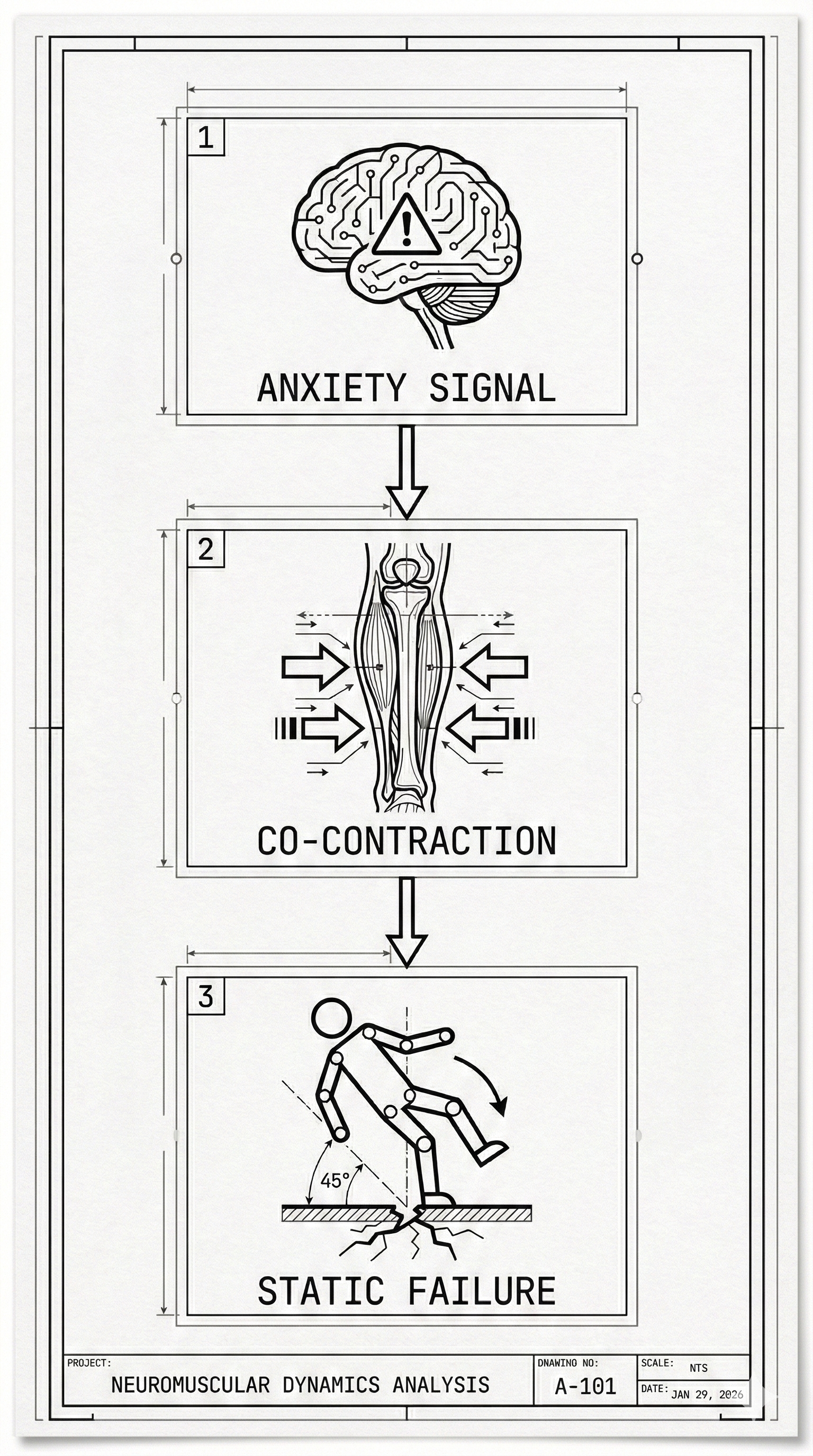
Fear triggers a biomechanical reaction called "co-contraction," where opposing muscle groups stiffen simultaneously. While this creates a sense of static safety, it destroys the dynamic flexibility required to recover from a trip.
The "Fear of Falling" (FOF) is not just a psychological state; it is a physiological one. When a senior is anxious, their brain triggers a "stiffening strategy". They instinctively tighten their shins and calves at the same time.
Think of it like this: A flexible athlete can stumble and recover because their muscles react fluidly. A stiff robot cannot; if it tips past a certain point, it simply falls over.
The Stiffness Paradox This is the clinical term for the counterintuitive reality where trying to be "rigid" for safety actually limits the body's natural righting reflexes, increasing the likelihood of a fall during movement.
A "Cautious Gait" is a maladaptive walking pattern characterized by slower speed, shortened steps, and a widened stance. This pattern decreases momentum and forces the brain to "over-think" walking, leading to cognitive overload.
When your parent adopts this guarded pattern, they are technically "corticalizing" their gait. Walking should be automatic, controlled by sub-cortical systems. But anxiety forces the Prefrontal Cortex to take over, using maximum cognitive horsepower just to monitor every step.
This leaves no "cognitive reserve" (bandwidth) to react to a sudden surprise. If they are thinking hard about walking, and a dog barks or they slip on a rug, the brain creates a bottleneck. It freezes.
Looking at the feet, or "Visual Locking," blocks "optic flow" data—the stream of visual information the brain needs to plan movement. It prevents the brain from scanning ahead for obstacles and anticipating terrain changes.
Anxiety forces the visual system to lock onto the ground to ensure safe foot placement. While this seems logical, it actually "blinds" the brain to the data it needs to balance.
The brain needs to look forward to feed motor planning data to the legs. When the gaze is anchored to the toes, the body creates a feedback loop of hesitancy and instability.
We must replace the "Fear Loop" with the "Fear Loop Protocol," a systematic approach that utilizes cognitive restructuring and sensory re-weighting to restore automatic movement.
We do not just encourage strengthening muscles; we have to unlock the stiffness to restore your parent’s natural righting reflexes.
The Fear Loop Protocol. A strategic intervention designed to deconstruct the biomechanical rigidity caused by anxiety. It moves the senior from a state of "Static Failure" to "Adaptive Stability" through cognitive unloading and gait retraining.
The goal is to shift the body’s operating system using these three levers:
- Cognitive Restructuring: We shift the internal narrative from "I will fall" to "How can I do this safely?" This turns the "red light" of fear into the "yellow light" of caution.
- Sensory Re-weighting: We train the brain to stop over-relying on vision (looking at feet) and trust proprioception (feeling the ground) again.
- Controlled Exposure: Just as vaccines protect against a virus, safe, graded exposure to balance challenges teaches the body the "muscle memory" needed to recover from a real trip without panic.
Feature
Muscle State
Visual Focus
Brain Usage
Result
The Fear Loop (Maladaptive)
Co-contraction (Rigid)
Gaze Anchored (Feet)
Cortical Overload (Thinking)
Static Failure
The Stability Protocol (Adaptive)
Relaxed Readiness (Flexible)
Scanning Forward (Optic Flow)
Sub-cortical (Automatic)
Adaptive Stability
The Next Step
If you notice your parent walking with a stiff, "robot-like" shuffle, they are already in the Fear Loop. "Being careful" is no longer enough; you need to audit the biomechanics of their fear.
This article gave you the intelligence. The Integrated Stability Blueprint gives you the plan.
